For most people in New Hampshire right now, buying an existing home is the faster, cheaper, and lower-risk path. The statewide median sale price for a single-family home hit $535,000 in 2025, while a realistic budget for a mid-range custom build lands around $600,000 to $683,000 once you add land, site work, and contingencies. Building takes 9 to 14 months. Buying takes 30 to 60 days after your offer is accepted.
But that doesn’t mean building is always the wrong call.
Building vs. buying in NH is a decision driven by three things: how much you can spend, how long you can wait, and how much uncertainty you’re willing to absorb. In 2026, New Hampshire’s housing inventory sits at roughly 2.1 months of supply (the NH Housing Finance Authority pegs the affordability index at just 58), so both paths come with trade-offs that didn’t exist five years ago.
This article breaks down costs, timelines, financing, and risks for each option. I won’t cover commercial construction, multi-family development, or buying land purely as an investment. Those are different animals.
When Does Buying Make More Sense?
Buying wins on speed. Full stop. If you need to move within 90 days (job relocation, school enrollment, lease expiring), building isn’t a realistic option. Cash buyers can close in as little as two weeks. Conventional mortgages typically close in 30 to 45 days.
Buying also wins on cost predictability. You see the price, you negotiate, you close. The inspection period gives you a window to catch problems before they become yours. I’ve seen dozens of buyers avoid five-figure surprises because a good inspector flagged a failing septic system or crumbling foundation before closing. If you’re selling a property at the same time, coordinating a build timeline on top of that creates a logistical headache most families don’t need.
Existing homes sit in established neighborhoods. You can check school ratings, drive the commute, and talk to neighbors before you commit. New subdivisions on the outskirts of towns like Londonderry or Bedford look great on paper, but amenities take years to show up.
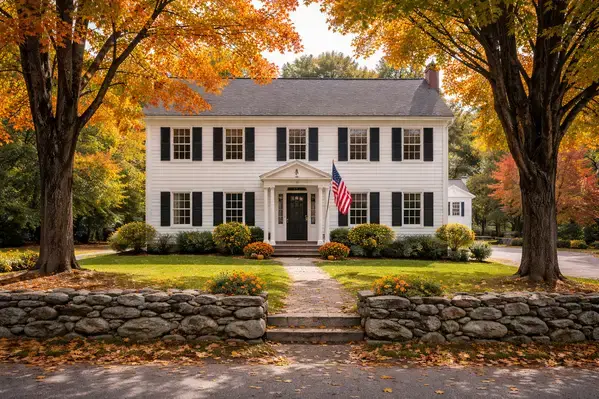
And then there’s character. A 1790 colonial in Portsmouth or an 1850s farmhouse in Amherst carries something a new build can’t replicate. If architectural history matters to you, buying is the only option.
New Hampshire’s statewide inventory is improving. As of late 2025, listings were up roughly 17% year over year, with over 4,500 homes available. That’s still a seller’s market by any measure, but it’s not the frenzy of 2021. If a well-maintained home hits the market in your price range and preferred town, the math rarely favors building.
When Building Is the Stronger Move
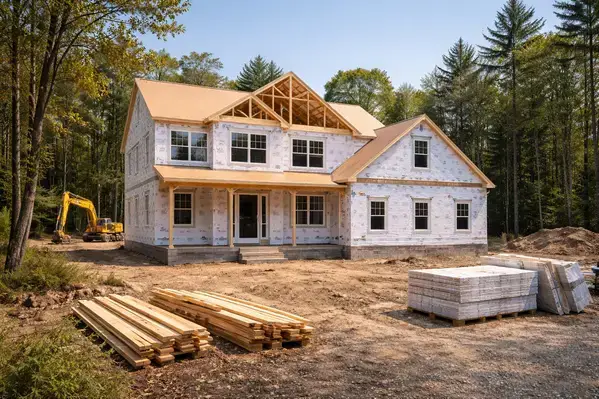
Building makes sense when the existing market can’t deliver what you need. And I mean need, not want. If you require a single-floor layout for accessibility, a specific orientation for solar gain, or a multi-generational floor plan, you’re unlikely to find it on the resale market in most NH towns.
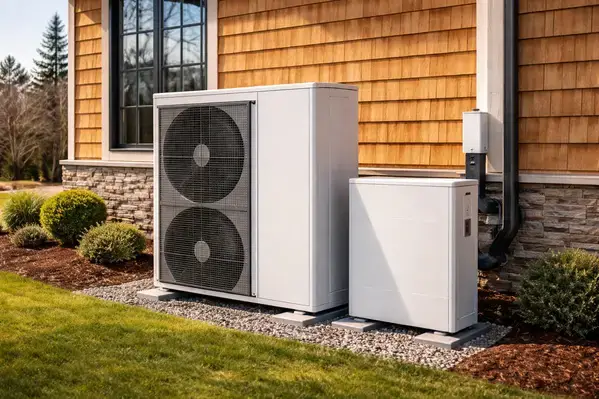
Energy performance is where new construction pulls ahead by the widest margin. Modern builds must meet current codes, and you can exceed them with spray-foam insulation, triple-pane windows, and heat pump systems. Local builder estimates suggest new homes can cut heating costs by 30% to 50% compared to pre-2000 homes. In a state where you’re running your furnace from October through April, those savings compound fast. The Harvard Joint Center for Housing Studies found that homes built after 2010 cost $4,300 to $4,500 per year in maintenance, while pre-1940 homes average $6,700.
Location control is the other big draw. You pick the lot. Want a south-facing view of the Whites? A wooded parcel near Squam Lake? Land in the Lakes Region and Monadnock area still runs well below Seacoast prices, and large parcels are available.
New materials also mean fewer repair surprises in the first decade. A new roof, HVAC system, and septic won’t need replacement for 15 to 25 years. Composite decking and fiber-cement siding hold up better than what you’ll find on most 1980s ranches.
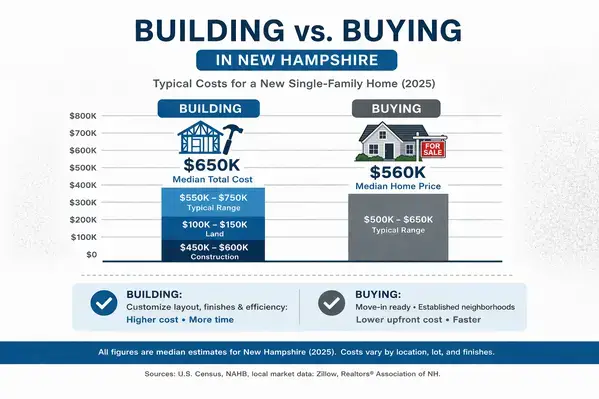
Here’s the contrarian take most articles won’t give you: building is not cheaper than buying in New Hampshire right now. The NHHFA reported a new construction median of $717,500 in May 2025, versus $565,000 for existing homes. National articles that claim building is cheaper are using averages from the South and Midwest, where land costs $15,000 and you don’t need to blast through granite ledge to pour a foundation. In NH, site work alone can run $50,000 to $150,000. Anyone telling you otherwise hasn’t priced a perc test in Grafton County.
How Do the Costs Actually Stack Up in 2026?
Comparing these two paths isn’t apples to apples. A resale home bundles land, structure, and site work into one price. A new build splits them into a dozen line items, each with its own potential for overruns. Here’s how the numbers break down based on 2025 data from the NAHB cost of construction survey and NH-specific builder estimates.
| Cost Factor | Buying Existing | Building New |
| Median Price (2025) | $535,000 statewide | $717,500 new construction |
| Seacoast/Rockingham | ~$689,000 | $800,000+ |
| Rural (Coos County) | ~$252,000 | $400,000+ total budget |
| Cost Per Sq Ft | Included in price | $175–$400 (construction only) |
| Land Cost | Included | $50,000–$200,000+ separate |
| Site Work | Included | $30,000–$150,000+ |
| Contingency Needed | 5% for updates | 10–15% of total budget |
| Timeline to Move In | 30–60 days | 9–14 months |
Source: NH Association of REALTORS 2025 data, NHHFA October 2025 report, NAHB 2024 Cost of Construction Survey. National average construction cost per square foot was $162 (NAHB), but NH runs 20% to 50% higher due to Northeast labor rates, weather constraints, and code requirements.
Site Work: The Budget Killer Nobody Talks About
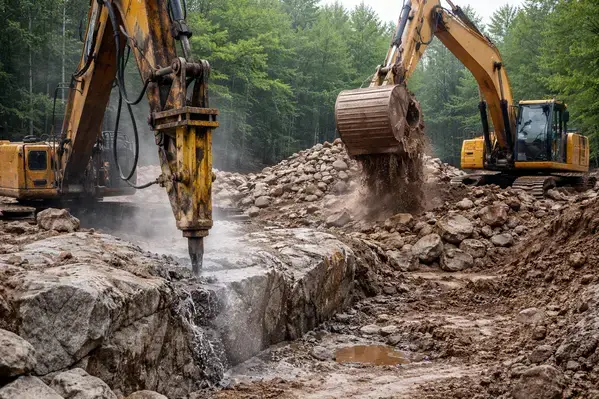
Clearing trees, grading, stump removal, ledge blasting, well drilling, septic installation, and driveway construction. These items can run from $30,000 on a flat, accessible lot with good soil to over $150,000 on a rocky, sloped parcel with poor drainage. Builders strongly recommend a feasibility study (perc tests and well yield tests) before you close on land. I’ve watched people buy a beautiful five-acre lot only to discover the soil won’t support a conventional septic system, adding $40,000 for an engineered alternative.
Allowances and Change Orders
Builders quote a base price with standard finishes. The numbers they include for cabinets, countertops, flooring, and fixtures are called allowances. A $5,000 cabinet allowance covers stock options from a box store. If you want soft-close drawers and custom panels, that number doubles or triples. Change orders (upgrades made after the contract is signed) are where budgets go sideways. I’ve seen builds come in 15% to 20% over the original contract because of change orders alone.
The Tariff Factor
The NAHB estimated in April 2025 that tariffs on imported lumber, steel, and appliances add roughly $10,900 to a typical new home. That number is baked into current builder quotes, but if tariff policy shifts again, your costs could move with it. Buying an existing home sidesteps this risk entirely.
What Should You Expect for Timelines?
Timelines are the clearest difference between these two paths.
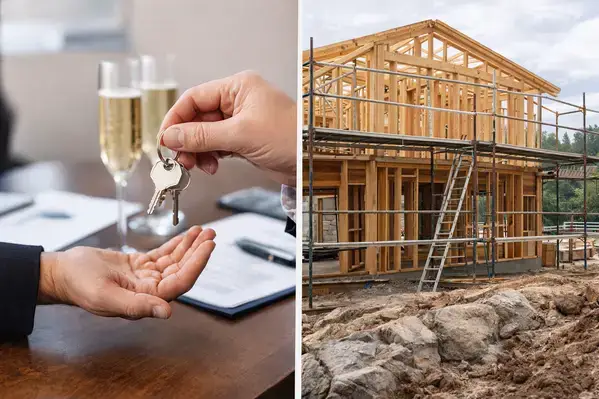
Buying is fast. Statewide, homes spent an average of 25 days on market before going under contract in 2025. Add 30 to 45 days for closing, and you could be moving in within two months of writing an offer. If you’re wondering how long the process takes from the seller’s side, the timeline is similar.
Building is slow. From land purchase to move-in, expect 9 to 12 months for a standard custom home. Complex builds, difficult lots, or permit backlogs push that to 14 months or longer. New Hampshire’s weather matters here. You can’t pour a foundation in January. Mud season (March through mid-April) stops site work cold. The effective construction window is roughly late April through November, which means a spring groundbreaking gets you a late-winter completion if everything goes right.
And things don’t always go right. Subcontractor shortages are real. The NAHB reported that 61% of builders cited labor availability as a significant challenge in 2024. In the Northeast, contractor payrolls are the smallest in the country, which means longer waits for framing crews, electricians, and plumbers.
Risk and Due Diligence on Both Sides
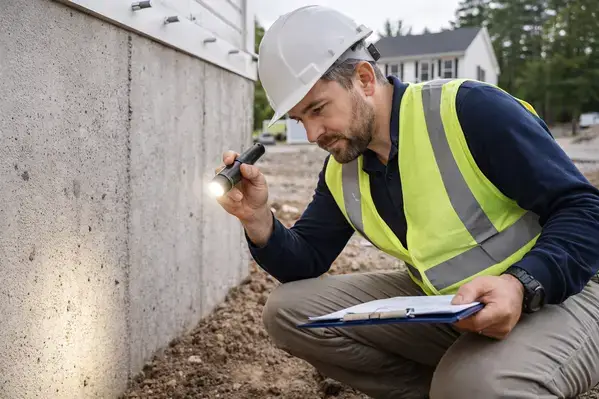
If you’re buying: Hire a good home inspector. Not the cheapest one. A thorough inspector will evaluate structural elements, roofing, mechanicals, and safety hazards like radon (common in NH’s granite bedrock). Research the neighborhood. Check how values have trended over the past five years. Look for pending zoning changes or development plans that could affect your property. Review the title, disclosures, and past permits. Understanding NH disclosure requirements will help you know what sellers are legally required to share.
If you’re building: Do your land homework before you close on a parcel. Perc tests, well yield tests, and soils analysis will tell you what you’re dealing with. Get a survey to confirm boundaries. Vet your builder the way you’d vet a business partner (because that’s what they are for the next year). Ask for references. Visit completed projects. Ask how they handle change orders and delays. Every NH town has different permitting rules, septic requirements, and road-access standards, so budget time and fees accordingly. Permit costs alone range from $500 to $3,000 depending on the municipality.
Financial risk management applies to both paths. Don’t stretch your budget to the breaking point. Keep reserves. And if you’re building, push for a fixed-price or capped-price contract that limits how much costs can escalate. An experienced marketing team that understands your market can also help you research comparable properties and pricing trends before you commit to either path.

How Do Construction Loans Differ From Standard Mortgages?
Buying: Conventional and Government-Backed Loans
Conventional loans are the standard for existing homes. Put 20% down and you skip private mortgage insurance. FHA loans allow 3.5% down but carry mortgage insurance premiums. VA loans offer 0% down with no PMI for eligible veterans. USDA loans support rural purchases with income limits, which covers much of northern and western New Hampshire.
As of early 2026, 30-year fixed mortgage rates sit in the mid-6% range. That significantly impacts purchasing power. The NHHFA reported the state’s 2025 affordability index at 58, meaning the median household income covers only 58% of what’s needed to qualify for the median-priced home at current rates. Only about 15% of NH households can afford the median $565,000 home.
Building: Construction-to-Permanent Loans
Construction-to-permanent loans fund periodic draws as the builder completes phases. During construction, you make interest-only payments on the amount drawn. Once the home is done, the loan converts to a permanent mortgage. These loans typically require 20% to 25% down (higher than most conventional options) and carry rates between 6.7% and 8.8%. You’ll pay closing costs on both the land purchase and the construction loan. Compare at least two lenders, because construction loan terms vary widely.
Steps to Buying an Existing Home in NH
- Set your budget. Meet with a local lender to get pre-approved. Decide what matters most: location, size, school district, or style. Be ready to compromise.
- Find a local agent. Work with someone who knows your target towns. In a market with just 2.1 months of inventory, speed matters.
- Tour homes and move fast. Visit properties that fit your criteria. When you find the right one, write the offer. Study comparable sales so your offer price is competitive but grounded.
- Negotiate contingencies. Standard contingencies include financing, inspection, and sometimes the sale of your current home. Balance protection with competitiveness.
- Do your due diligence. Schedule inspections. Review HOA docs for condos. Confirm insurance availability. Use any major findings to renegotiate. Understanding the full closing process in NH will help you avoid last-minute surprises.
- Close and move in. Once your loan clears and contingencies are met, sign the papers, grab the keys, and start unpacking.
Steps to Building a New Home in NH
- Get financing locked. Obtain pre-approval for a construction-to-permanent loan. Set your total budget, including land, site work, and a 10% to 15% contingency. Do not skip the contingency.
- Find the right land. Search for parcels that meet your location, size, and zoning needs. Confirm whether utilities are available or if you’ll need a well and septic.
- Test the land before you buy it. Hire professionals for soil testing, percolation, and well capacity. Check building restrictions, road frontage requirements, and environmental factors. This step saves people from six-figure mistakes.
- Choose a builder and design. Interview at least three builders. Review their completed projects. Compare estimates line by line. Decide if you want a full custom design or a modified stock plan.
- Finalize plans and pull permits. Work with your builder (and an architect if needed) to finalize drawings. Submit permit applications for building, septic design, driveway access, and any wetlands or conservation approvals. Budget $500 to $3,000 for permit fees.
- Break ground and stay involved. Once permits clear, construction begins with excavation, foundation, and framing. Attend regular site meetings. Confirm finish selections before deadlines pass. Don’t let decisions pile up.
- Final inspections and closing. Town inspectors verify code compliance at key stages. When the home is complete, your construction loan converts to a permanent mortgage and you move in.
Resale, Sustainability, and the Bigger Picture
New Hampshire’s median single-family home price has risen roughly 71% since 2019. That’s rewarded homeowners across both categories. But location and condition remain the primary drivers of appreciation, not whether the home was new or existing when you bought it.
Building lets you design for energy performance from day one, and that’s a legitimate advantage. But renovating an existing home can be sustainable too, especially if the structure is sound. You avoid the embodied carbon cost of a ground-up build. The NH Department of Business and Economic Affairs reports that the state issued 5,822 housing permits in 2024 (the highest since 2006), but still needs 88,364 more units by 2040. That supply gap keeps existing home values strong. If you buy in a desirable location and make targeted improvements, you’ll likely see solid appreciation.
And don’t overlook temperament. Some people love the process of watching a house take shape over months. Others would rather spend weekends exploring their new town instead of reviewing tile samples at a showroom. Know which person you are before you commit.
The Real Decision
Building vs. buying in NH isn’t about which option is objectively better. It’s about which one fits your timeline, your budget, and your tolerance for the unexpected. If you need to move soon and you find the right home on the market, buy it. If the market can’t give you what you need and you have 12 or more months to wait, building might be your best path.
Work with a local agent who knows your target towns, a lender who has closed construction deals in NH, and (if building) a builder with a track record you can verify. Whether you end up in a restored farmhouse on the Seacoast or a new build overlooking the White Mountains, the common thread is doing your homework before you write a check. For homeowners on the other side of this decision who are ready to sell, companies that buy houses for cash in NH can make the transition between homes much smoother.
FAQs
Is it cheaper to build or buy a house in New Hampshire in 2026?
Buying is cheaper for most people right now. The statewide median for an existing single-family home was $535,000 in 2025, while the median for new construction hit $717,500 (NHHFA, October 2025). A realistic total budget for a mid-range custom build runs $600,000 to $683,000 once you add land, site work, and contingencies. Building only pencils out as “cheaper” if you find affordable land with minimal site-prep costs.
How long does it take to build a house in New Hampshire?
From land purchase to move-in, expect 9 to 14 months for a standard custom home. The effective construction season runs roughly late April through November due to weather. Subcontractor shortages can add weeks. The NAHB found that 61% of builders reported labor shortages in 2024, and Northeast wait times for specialty trades are the longest in the country.
What are the hidden costs of building on raw land in NH?
Site work is the biggest surprise. Septic installation, well drilling, ledge blasting, tree clearing, and driveway construction can add $50,000 to $150,000 beyond your base construction contract. Always run perc tests and well yield tests before closing on land. Permit fees range from $500 to $3,000 depending on the town.
How do construction loan rates compare to regular mortgages?
Construction loans typically require 20% to 25% down (compared to 3.5% to 20% for conventional or FHA loans) and carry interest rates between 6.7% and 8.8% during the build phase. Once construction is complete, the loan converts to a standard mortgage. You’ll also pay closing costs on both the land purchase and the construction loan.
Does building a new home in NH save money on energy costs?
Yes. New homes built to current codes with high-performance insulation and modern HVAC systems can reduce heating costs by 30% to 50% compared to pre-2000 homes. The Harvard Joint Center for Housing Studies found that homes built after 2010 average $4,300 to $4,500 per year in maintenance costs, versus $6,700 for pre-1940 homes.
What should I budget for building a new home in New Hampshire?
Construction costs range from $175 to $300 per square foot for standard builds and $350 to $400+ for high-end custom homes. For a 2,000-square-foot home at $238 per square foot, construction alone runs about $476,000. Add land ($50,000 to $200,000+), site work ($30,000 to $150,000+), and a 10% to 15% contingency to get your realistic total.
Are there any building incentives or programs in NH for 2026?
New Hampshire offers InvestNH grants and zoning reform incentives. The NH Housing Finance Authority provides down payment assistance programs. Communities designated as Housing Champions (representing 45% of 2024 permits, per the NH BEA) may offer streamlined permitting. Check with your local planning board and NHHFA for current program availability.