Buying a home in New Hampshire is one of the smarter real estate moves you can make in 2026, but only if you go in with your eyes open. The state has no income tax, no sales tax, a record median home price of $535,000, and roughly 2 months of inventory. That combination means real savings for the right buyer and brutal competition for everyone else.
Here’s the short version: if you earn above $120,000 a year (or you’re relocating from a high-tax state like Massachusetts), the math works strongly in your favor. If you’re a median-income household at around $96,800, you’ll need to get creative with location, loan programs, or both. New Hampshire rewards informed buyers and punishes those who don’t do their homework on property taxes, town-level pricing, and closing costs.
This won’t be a cheerful tourism pitch. I’ve watched too many buyers get blindsided by $20,000+ property tax bills or bidding wars fueled by out-of-state cash offers. We’ll cover the real financial picture, region-by-region pricing, and where the actual opportunities sit heading into 2026.
What Makes New Hampshire a Smart Place to Buy Right Now?
New Hampshire is one of only a handful of states with no personal income tax and no sales tax. As of January 1, 2025, the state also killed its tax on interest and dividends, making it a zero-income-tax state for the first time. For buyers moving from Massachusetts (where you’d pay 5% on wages) or Vermont (5.75%), those savings add up fast.
But the tax story is only half the picture. The housing market is stabilizing after years of aggressive price increases, inventory is slowly climbing, and the state passed several pro-housing laws in 2025 that should add supply over the next few years. It’s still a seller’s market. It’s just less of a knife fight than it was in 2022 or 2023.
How Do New Hampshire’s Tax Advantages Save You Money?
The tax structure is the single biggest financial reason people buy in New Hampshire. And it deserves more than a surface-level summary, because the savings (and the trade-offs) depend entirely on your income and which town you pick.
No Income Tax and No Sales Tax
New Hampshire charges zero state income tax on wages. Zero on investment income. Zero on dividends. It’s now one of only five states nationwide with no personal income tax at all.
There’s also no sales tax. Buy a $3,000 couch in Massachusetts, and you’ll pay $187.50 in tax. Buy it in New Hampshire, and you keep that money. For a household spending $50,000 a year on goods, that’s roughly $3,500 in annual savings from sales tax alone. Over 30 years, it compounds past $100,000.
I’ve seen people dismiss these savings as marginal. They’re not. A remote worker earning $150,000 who moves from Massachusetts to New Hampshire saves $7,500 a year in state income tax. Over the life of a 30-year mortgage, that’s $225,000. That’s a down payment. That’s a renovation budget. That’s real money.
Where Does NH Rank for Tax Competitiveness?
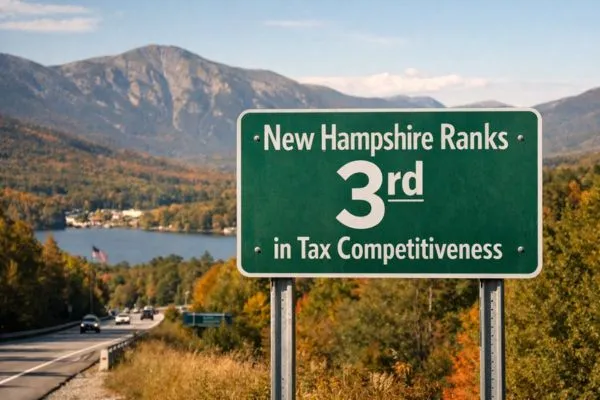
According to the 2026 State Tax Competitiveness Index, New Hampshire now ranks 3rd nationally for overall tax competitiveness. That’s a big jump, driven largely by the dividend and interest tax elimination. It puts NH ahead of most of its neighbors and makes it increasingly attractive to higher earners, retirees, and business owners looking to relocate.
For retirees specifically, the math is striking. Someone with $1 million in investments generating $40,000 a year in dividends pays zero state tax in New Hampshire. In Massachusetts, that same person owes about $2,000. In Vermont, roughly $2,300. Those dollars matter when you’re living on a fixed income.
What About Property Taxes?
Here’s where the contrarian take comes in: most “best places to buy” articles gloss over New Hampshire’s property taxes. Don’t let anyone do that to you.
New Hampshire’s effective property tax rate runs between 1.41% and 1.46% of assessed home value. That’s among the highest in the country. On a $535,000 home, you’re looking at $7,600 to $7,800 a year.
But that number is misleading because property tax rates vary wildly by town. Rates range from $5.39 per $1,000 of assessed value in some towns to over $25 per $1,000 in others, according to the NH Department of Revenue’s 2025 municipal data. A $600,000 home could cost you $3,200 a year in one town and $15,000 in the next one over. If you don’t research the specific town rate and any upcoming reassessments before making an offer, you’re gambling with thousands of dollars a year.
Even so, the overall tax burden still favors NH. Residents pay roughly 6.9% of income in state and local taxes, compared to 8.9% in Massachusetts and 10.8% in Vermont. A family earning $100,000 saves about $1,950 a year compared to living in Massachusetts and $3,900 compared to Vermont. Property taxes are the trade-off. For most buyers above median income, they’re a trade-off worth making.

What Does the New Hampshire Housing Market Look Like in 2026?
The market is competitive but cooling. That’s actually good news for buyers who’ve been sitting on the sidelines.
Median Home Prices and Appreciation
New Hampshire hit a record median single-family home sale price of $535,000 in 2025, a 3.9% increase from the previous year’s $515,000, according to the New Hampshire Association of Realtors (NHAR) year-end report published January 7, 2026. Zillow pegs the average home value at about $495,256 as of February 2026, up 2.7% year-over-year. Redfin’s February 2026 data shows a median of $483,800 across all home types.
Those numbers tell you two things. First, prices are still going up. Second, the rate of increase is slowing down. NHAR President Josh Greenwald put it this way in January 2026: home prices are still rising faster than inflation, but the pace is starting to ease. Forecasters expect 2–4% appreciation in 2026. That’s sustainable growth, not a bubble.
If you’re waiting for a crash, stop. The data doesn’t support it. Inventory is too low, demand from out-of-state buyers is too strong, and sellers locked into sub-4% mortgage rates aren’t flooding the market.
How Much Inventory Is Available?
The state has about 2 to 2.5 months of inventory. A balanced market needs 5–7 months. So yes, it’s still tilted toward sellers.
But it’s better than it was. Single-family home inventory rose 12.8% year-over-year in 2025, and new listings jumped 15.9%. NHAR reported 12,529 single-family home closings in 2025, up 4.5% from 2024. Homes spend an average of 46 days on the market before going under contract.
That said, those statewide numbers hide some dramatic local variation. In the Seacoast (Portsmouth, Hampton), homes move faster and cost more. In northern counties like Coos and Sullivan, prices have been flat or declining, but so have services and job access. The “average” market doesn’t exist. Your market is whatever town you’re targeting.
Regional Price Differences Worth Knowing
This is where buying a home in New Hampshire gets interesting.
| Region | Approx. Median Price | Key Notes |
| Seacoast (Portsmouth/Hampton) | $550,000+ | 11.2% YoY appreciation, strongest demand, premium pricing |
| Manchester-Nashua | ~$550,000 | Ranked among the hottest U.S. markets in early 2026 |
| Lakes Region | $500,000–$600,000+ | Vacation/second-home demand, Airbnb investor activity |
| Monadnock Region | $350,000–$450,000 | More affordable, fewer services, quieter market |
| North Country (Coos/Sullivan) | $250,000–$350,000 | Flat/declining prices, limited jobs, lowest entry point |
The Seacoast and Manchester-Nashua corridors get the headlines. But if you want to actually find value, look at the Monadnock Region or the towns circling the Lakes Region that aren’t directly on the water. You still get New Hampshire’s tax advantages without paying Seacoast premiums.
One thing the national “best places” articles never mention: roughly 14.5% of New Hampshire homes sit vacant as seasonal or second homes. That pulls year-round inventory down far more than the official “months of supply” number suggests. It’s a hidden factor that keeps prices stubborn even as new listings tick up.

Is New Hampshire’s Quality of Life as Good as People Say?
Mostly yes. A few caveats.
Healthcare Rankings
New Hampshire ranked as the best state for overall healthcare in 2025 according to WalletHub, scoring 2nd for cost and 2nd for outcomes. The Commonwealth Fund ranked it 3rd for health system performance, and the United Health Foundation named it the healthiest state in the country. Those aren’t cherry-picked stats. The state has the 4th-lowest out-of-pocket medical spending nationally, the 5th-highest nurse-to-population ratio, and some of the lowest rates of diabetes and heart disease in the U.S.
For families and retirees, that matters more than most people realize when picking a state to buy in.
Education and Safety
Public schools consistently rank in the top tier nationally. Dartmouth College and the University of New Hampshire anchor higher education. Crime rates run well below national averages. None of this is flashy, but it’s the kind of slow-burn quality-of-life advantage that protects property values over decades.
I won’t pretend rural NH schools are identical to those in Bedford or Exeter. They’re not. School quality varies by district, and if you have kids, researching the specific district matters more than the statewide ranking.
Outdoor Recreation and Location
White Mountains skiing. Lakes Region boating. An 18-mile seacoast. Four distinct seasons. This is what sells the lifestyle pitch.
The positioning is genuinely good. Boston is about an hour south. Montreal is a few hours north. You get rural space without total isolation. Manchester-Boston Regional Airport handles regional flights. And if you work remotely, the combination of outdoor access and quiet living is hard to beat for the price (compared to, say, Vermont or coastal Maine).

How Strong Is New Hampshire’s Economy?
Strong enough to justify buying, with a few soft spots worth watching.
Employment and Major Employers
The state had 757,500 employed residents as of mid-2025. Job growth slowed in early 2025, with employers focused on holding staff rather than expanding. Healthcare and social assistance drove recent hiring, while retail trade lost about 2,000 jobs and accommodation/food services shed 1,400.
Major employers span defense (BAE Systems), finance (Fidelity Investments), insurance (Liberty Mutual), and regional health systems. That mix gives the economy some resilience. It’s not a one-industry state.
Labor force participation sits at 65%, and the job openings rate was 3.4% in December 2025 per BLS data. Not as hot as 2022, but still a functional labor market.
New Housing Laws That Help Buyers
This is underreported. In 2025, Governor Ayotte signed several pro-housing bills that directly affect inventory for buyers:
- HB 577 (ADU Law 2.0) allows detached accessory dwelling units by right
- HB 631 permits multi-family residential in commercial zones
- HB 2 (Partners in Housing) speeds up permitting
The state also designated 28 municipalities as Housing Champions with special development incentives. And building permits hit 5,822 units in 2024, the highest since 2005.
Here’s the catch that developers won’t tell you: 62% of those 2024 permits were for multi-family units. If you’re a family looking for a single-family home, most of that new supply doesn’t help you directly. And 23 towns accounted for 63% of all new units, leaving rural areas largely untouched.
How Does New Hampshire Compare to Neighboring States?
| Factor | New Hampshire | Massachusetts | Vermont | Maine |
| Median Home Price (2025) | $535,000 | $646,000 | $390,220 | $391,452 |
| State Income Tax | 0% | 5% | 5.75% | 5.8% |
| Sales Tax | 0% | 6.25% | 6% | 5.5% |
| Effective Property Tax Rate | 1.41–1.46% | ~1.12% | ~1.83% | ~1.09% |
| State/Local Tax Burden (% of income) | 6.9% | 8.9% | 10.8% | 9.7% |
| Electricity (cents/kWh) | 23.4¢ | 21.8¢ | 19.3¢ | 20.4¢ |
New Hampshire is more expensive than Vermont and Maine for the home itself, but cheaper once you factor in the total tax picture. It’s significantly cheaper than Massachusetts on both price and taxes. The one area where NH costs more: electricity, at 23.4 cents per kWh versus 19–22 cents in neighboring states.
The Manchester-Nashua area runs about $2,106 per month for average rent, well below Boston-area rates. For renters considering a purchase, the spread between renting in Boston and owning in southern NH is where the financial case gets strongest. Anyone evaluating closing costs in the Granite State should also budget 2.33–3.47% of purchase price, or roughly $11,650–$17,350 on a $500,000 home, according to Rocket Mortgage’s February 2026 analysis. NH also charges a real estate transfer tax of $0.75 per $100 of value on both buyer and seller.
Why Are Remote Workers Flocking to New Hampshire?
The remote work migration story isn’t hype. It’s math.
A professional earning $150,000 who works remotely from Massachusetts pays $7,575 in state income tax each year. The same person doing the same job from a home in New Hampshire pays $0. Over 30 years, that’s $227,250 in savings.
Southern New Hampshire has been the biggest beneficiary. Towns within commuting distance of Boston (even occasional commuting) saw the steepest price increases from 2020 to 2024. The Manchester-Nashua metro was ranked among the top 2 hottest housing markets in the country by Realtor.com in early 2026. That demand isn’t slowing down.
About 20% of remote workers planned to relocate in 2025, according to national surveys, and flexible work arrangements look permanent. For buyers from high-tax states, NH offers the rare combination of lower taxes, good schools, and a reasonable drive to a major metro when you need it. The trade-off is that all those relocating buyers (many paying cash, many from Massachusetts and New York) are exactly why cash offers dominate in desirable towns and why local families earning the median income have been squeezed out.
NHAR data shows the affordability index hit 59 in late 2025, meaning a household earning the median income of $96,838 has only 59% of what’s needed to qualify for a mortgage on the median-priced home. Only about 15% of NH households earn the $158,000–$182,000 needed to comfortably afford a $535,000 purchase.
That’s the part nobody’s comfortable saying out loud: New Hampshire’s housing market works great if you’re bringing outside wealth. For long-time locals earning local wages, it’s gotten brutal.

Can You Actually Afford to Buy in NH?
The median home at $535,000 requires roughly 5.5 times the median household income. That’s elevated by historical standards but manageable for dual-income households above $120,000 or relocators with existing equity.
The NH Housing Finance Authority’s 2025 Homebuying Sentiment Survey found that 87.8% of active buyers expected to spend under $450,000. That gap between what buyers want to spend and what’s actually available tells you everything about where the market friction sits.
If you’re priced out of the Seacoast or Manchester corridor, look at these strategies:
The Monadnock Region, Lakes Region periphery, and parts of the Upper Valley offer meaningful discounts compared to southern NH. Condos and townhomes provide entry points below $350,000 in some areas. The state’s InvestNH program (a $100 million economic development initiative) and Housing Champions designations in 28 municipalities are pushing new development, though it takes time for permits to become livable homes.
And if you’re selling another property to fund this purchase, understanding your capital gains tax exposure is worth sorting out early. The wrong assumptions about exemptions can cost tens of thousands at closing.
The Bottom Line for 2026 Buyers
Buying a home in New Hampshire in 2026 comes down to one question: Does the tax savings math work for your household? For buyers earning above $120,000, for remote workers leaving high-tax states, and for retirees sitting on investment income, the answer is almost always yes. The combination of zero income tax, zero sales tax, 2–4% annual appreciation, and top-tier healthcare and education creates a financial and lifestyle package that a marketing partner who understands your market can help you communicate to the right audience.
For median-income locals, the picture is harder. Inventory is still tight. Cash-heavy out-of-state buyers set the pace. And property taxes can ambush you if you don’t research the specific town.
The market isn’t crashing. Prices aren’t dropping. But the rate of increase is slowing, inventory is climbing (slowly), and new housing laws should add supply over the next few years. If you’re positioned to buy, 2026 offers a better entry point than 2023 or 2024 did. Just don’t skip the disclosure and due diligence step that protects you from surprises after closing.
Frequently Asked Questions
Will home prices in New Hampshire drop in 2026?
No. Every major forecast projects 2–4% appreciation in 2026, not a price decline. Inventory is rising modestly (single-family listings up 12.8% year-over-year in 2025), but it’s still far below the 5–7 months needed for a balanced market. Sellers locked into low mortgage rates aren’t listing in large numbers, and demand from out-of-state buyers remains strong. If you’re waiting for a crash, the data doesn’t support that bet.
How much do you need to earn to buy a home in New Hampshire?
For the median-priced home at $535,000, you’d need a household income between $158,000 and $182,000 to keep housing costs at 30% of income. New Hampshire’s median household income is about $96,838, which means most local families can’t comfortably qualify for the median home. NHAR’s affordability index dropped to 59 in late 2025, the lowest on record.
Does New Hampshire’s lack of income tax make up for high home prices?
For higher earners, yes. A household earning $150,000 saves roughly $7,500 per year in state income tax compared to Massachusetts. Over 30 years, that’s over $225,000 in tax savings. But for median-income families facing monthly payments around $3,950 on the median home, the tax advantage alone doesn’t close the affordability gap.
Are property taxes really that high in New Hampshire?
It depends on the town. Rates range from $5.39 to over $25 per $1,000 of assessed value according to the NH Department of Revenue’s 2025 data. A $600,000 home could cost $3,200 a year in one municipality and $15,000 in another. Researching the exact rate in your target town (and any upcoming reassessments) is one of the most overlooked steps in buying a home in New Hampshire.
Is New Hampshire still a seller’s market in 2026?
Yes, but it’s easing. Inventory sits around 2–2.5 months of supply, still well below balanced-market levels. However, new listings increased 15.9% year-over-year in 2025, and total closings rose 4.5% to 12,529 single-family homes. The market is shifting slowly toward buyers, but it’s not there yet.
What are the best regions for affordable homes in NH?
The Monadnock Region, parts of the Upper Valley, and northern areas like Coos County offer entry points between $250,000 and $450,000. These areas have fewer services and job options than southern NH, but they give you full access to New Hampshire’s tax advantages and quality of life at a fraction of Seacoast or Manchester-Nashua prices.
Should first-time buyers wait or buy now in New Hampshire?
Waiting carries risk. Prices are projected to rise 2–4% in 2026, meaning a $500,000 home could cost $10,000–$20,000 more by next year. Mortgage rates have eased slightly toward 6.3%, and inventory is improving. If you can afford current payments and find the right town, buying now locks in today’s price and starts building equity while appreciation works in your favor.