
New Hampshire, Maine, and Massachusetts sit within a few hours of each other, but your monthly expenses can swing by hundreds of dollars depending on which state you pick. The cost of living in New Hampshire vs Maine vs Massachusetts comes down to a trade-off between taxes, housing prices, and what you actually earn. New Hampshire has no income or sales tax. Maine has the lowest median home prices in the region. Massachusetts charges the most across the board but pays the highest salaries. None of them is a clear winner for everyone.
The cost of living in New Hampshire vs Maine vs Massachusetts depends on your income, family size, and whether you work locally or remotely. New Hampshire’s cost-of-living index sits at 111.4, Maine at 113.0, and Massachusetts ranges from 141.2 to 148.0 against a national baseline of 100, according to BEA regional price parity data aggregated for 2026.
How Much Does It Cost to Live in New Hampshire in 2026?
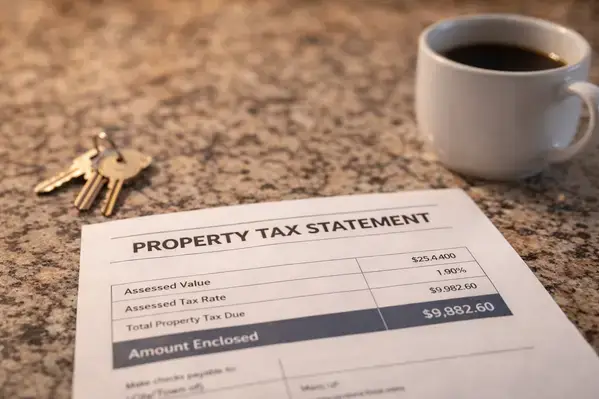
New Hampshire looks cheap on paper. No state income tax (the interest and dividends tax was fully repealed in 2025). No sales tax. But those headlines hide a big number: property taxes.
NH has the third-highest property tax rates in the country. On a median-priced home of $527,700 (per HUD’s November 2024 Comprehensive Housing Market Analysis), that means roughly $10,000 to $15,000 a year just in property taxes. Add insurance, and the NH Fiscal Policy Institute puts the total monthly ownership cost for a median buyer at about $3,937. That’s close to 47% of median household income.
Statewide average rent reached $1,996 per month in Q3 2024, with the southern Manchester-Nashua corridor hitting $2,083 (HUD data). That’s $262 above the national average of $1,734. And inventory is tight. Only 2.5 months of supply sat on the market through October 2024, with home sales down 14% year over year.
I’ve seen a lot of people relocate from Boston to southern NH expecting a windfall from zero income tax. Most of them break even once they factor in property taxes and the higher cost of goods (no sales tax doesn’t mean lower prices; it means retailers pocket the margin).

Is Maine Really Cheaper Than New Hampshire?
On housing alone, yes. Maine’s median home prices are still well below New Hampshire’s, though the gap is closing fast. Prices jumped over 50% between 2020 and 2024 while wages grew less than 33%, according to the Maine State Housing Authority’s January 2025 Outlook report. Research Director Jonny Kurzfeld flagged this wage-price gap as a growing barrier for first-time buyers.
Maine’s overall cost-of-living index (113.0) is slightly higher than NH’s (111.4). That surprises people. The reason is taxes: Maine charges a state income tax up to 7.15% and a 5.5% sales tax. Heating bills also run higher. If you’re buying rural property in central Maine, you’ll save on the purchase price but pay more on fuel oil from November through April.
The state added $20 million in affordable housing funding and an $18 million rent relief pilot in its April 2024 supplemental budget (noted in a Boston Fed analysis). That’s a step, but 775 affordable units completed in 2024 barely dents the need. Construction employment did grow 7.3% from 2023 to 2024, so the building pipeline is expanding.

Why Does Massachusetts Cost So Much More?
Massachusetts isn’t just expensive. It’s a different tier. The cost-of-living index ranges from 141.2 to 148.0, depending on the source, meaning everyday costs run 41% to 48% above the national average. The median monthly owner cost with a mortgage hit $2,755 in 2024 Census data, one of the five highest figures in the country.
Median home prices sit around $580,000 to $630,000 statewide, and inside the Boston metro you’re looking at much more. Add a flat 5% state income tax, 6.25% sales tax, and moderate property taxes, and you feel it everywhere. Groceries and gas rank among the priciest in New England.
But here’s the contrarian take most cost-of-living articles skip: Massachusetts salaries are significantly higher. A household earning $120,000 in the Boston metro might only earn $80,000 doing the same job in Manchester, NH or Portland, Maine. After you adjust for income, the effective cost burden can actually be lower in MA for mid-to-high earners. That math doesn’t work for retirees or remote workers whose pay doesn’t change by location.
How Do New Hampshire, Maine, and Massachusetts Compare Side by Side?
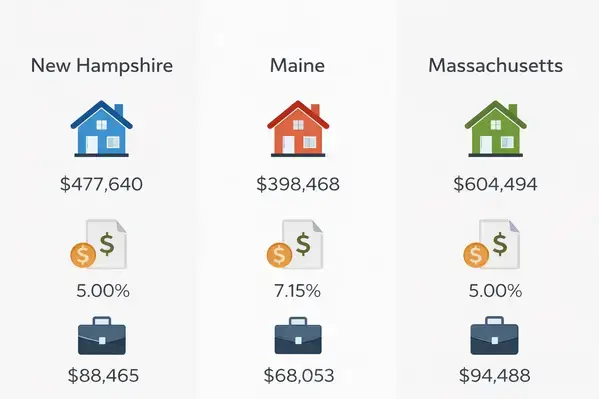
This table uses 2024 and early 2026 figures from HUD, the Census Bureau, NAR, and BEA data. Numbers tell one story. Your household situation tells another. A retired couple and a dual-income family with kids will rank these states very differently.
| Metric | New Hampshire | Maine | Massachusetts | Source |
| COL Index (100 = national avg) | 111.4 | 113.0 | 141.2–148.0 | BEA / WPR 2026 |
| Median Home Price (2024) | $527,700 | ~$385,000–$420,000 | $580,000–$630,000 | HUD / NAR |
| Avg. Monthly Rent | $1,996 | ~$1,700 | Higher (Boston metro) | HUD Q3 2024 |
| State Income Tax | None | Up to 7.15% | Flat 5% | State revenue depts |
| State Sales Tax | None | 5.5% | 6.25% | State revenue depts |
| Property Tax Rank | 3rd highest | Mid-range | Moderate | Tax Foundation |
| % Priced Out of Median New Home | 83.4% | 82.7% | High (not broken out) | NAHB Feb 2026 |
| Real Estate % of GSP (2024) | 17.2% ($19.7B) | 19.5% ($18.3B) | 17.6% ($132.8B) | NAR Jan 2025 |
Which New England State Gives You the Best Tax Deal in 2026?
New Hampshire wins on headline taxes, but that’s only part of the picture. With no income or sales tax, your paycheck and shopping cart stretch further on the surface. The catch: those sky-high property taxes fill the gap. A homeowner sitting on a $527,700 property is likely paying $11,000 to $14,000 a year in property taxes alone.
Maine taxes income aggressively (top bracket 7.15%) and adds a 5.5% sales tax. But its property taxes are more moderate. For renters, Maine’s tax structure can actually be lighter overall than NH’s ownership-heavy model.
Massachusetts runs a flat 5% income tax plus 6.25% sales tax, but its property taxes are lower relative to home values than NH’s. Combine that with higher wages, and high earners often come out ahead in MA after all taxes are paid. The state also created the Executive Office of Housing and Livable Communities in 2023, with ongoing 2024 to 2025 implementation aimed at housing production.
What’s the Real Answer on New England Cost of Living?
There’s no single cheapest state. It depends on who you are. If you’re a retiree with pension income and no mortgage, New Hampshire’s zero income tax makes a real difference. If you’re a young family buying your first home, Maine’s lower entry price is hard to ignore (even with income taxes eating into your paycheck). If you’re a dual-income household earning $150,000 or more, Massachusetts might cost the least after adjusting for salary, especially if you need public transit or top-tier schools.
The biggest mistake I see people make is comparing sticker prices without adjusting for income. A $385,000 house in rural Maine sounds like a steal until you realize your salary dropped $30,000 to move there. The cost of living in New Hampshire vs Maine vs Massachusetts is personal math, not a ranking. Run your own numbers, starting with what you’ll actually earn in each state, before picking a zip code. If you’re planning to sell a home as part of that move, talking with a team that knows all three markets can save you more than any tax calculator.
FAQs
Is New Hampshire actually cheaper than Massachusetts once you factor in everything?
Not always. Southern New Hampshire housing now rivals eastern Massachusetts prices, and median home buyers in NH face roughly $3,937 in monthly ownership costs (including taxes and insurance) per NH Fiscal Policy Institute data. Massachusetts salaries often run $20,000 to $40,000 higher for the same role, which can offset the income tax difference. For high earners, Massachusetts may cost less after adjusting for pay.
How much does a median home cost in New Hampshire in 2026?
The statewide median home sales price reached $527,700 as of HUD’s November 2024 CHMA report, a 7% year-over-year increase. New construction is even pricier at $720,400. Southern submarkets near Manchester and Nashua averaged $502,800, still well above the national median.
Why are Maine home prices rising faster than wages?
Maine saw over 50% home price growth from 2020 to 2024, while wages grew less than 33.3% in the same period (Maine State Housing Authority, January 2025). Limited new construction (just 775 affordable units completed in 2024) keeps supply tight. Demand from remote workers relocating from Boston and New York continues to push prices higher in coastal and southern Maine.
What’s the real monthly cost of owning a home in these three states?
In New Hampshire, the NH Fiscal Policy Institute estimates about $3,937 per month for a median-priced home including mortgage, taxes, and insurance. Massachusetts median monthly owner costs with a mortgage hit $2,755 per 2024 Census ACS data, though that figure varies widely by county. Maine ownership costs are lower at entry but heating expenses ($200+ per month in winter) and income taxes add up over a full year.
Does moving to Maine save money on cost of living compared to New Hampshire?
On housing, yes. Maine’s median home prices remain roughly $100,000 to $140,000 below New Hampshire’s. But Maine’s cost-of-living index (113.0) is slightly higher than NH’s (111.4) because of income taxes (up to 7.15%), sales taxes (5.5%), and elevated heating costs. Rural Maine offers the biggest savings, but job options and wages are limited outside Portland and Bangor.
How tight is the housing inventory in New Hampshire right now?
As of October 2024, New Hampshire had 2.5 months of housing inventory, up slightly from 2.3 months but still well below the 6-month level considered balanced (HUD CHMA data). Home sales dropped 14% year over year, yet prices still climbed 7%. Nationally, inventory averaged 3.7 months, making NH noticeably tighter than the U.S. overall.
Should I buy now or wait for prices to drop in New England?
Waiting has been a losing bet in New England. Northeast home prices rose 6.8% year over year into Q1 2025, the highest regional gain in the country and a 68% increase since 2019 (Harvard JCHS, June 2025). Inventory is easing slightly in New Hampshire, but no major correction is expected while supply stays below 3 months. Waiting another year could mean paying $30,000+ more for the same house.